What if you had almost unlimited power, would anything still be impossible?
There’s a thought experiment that completely breaks our intuition about strength.
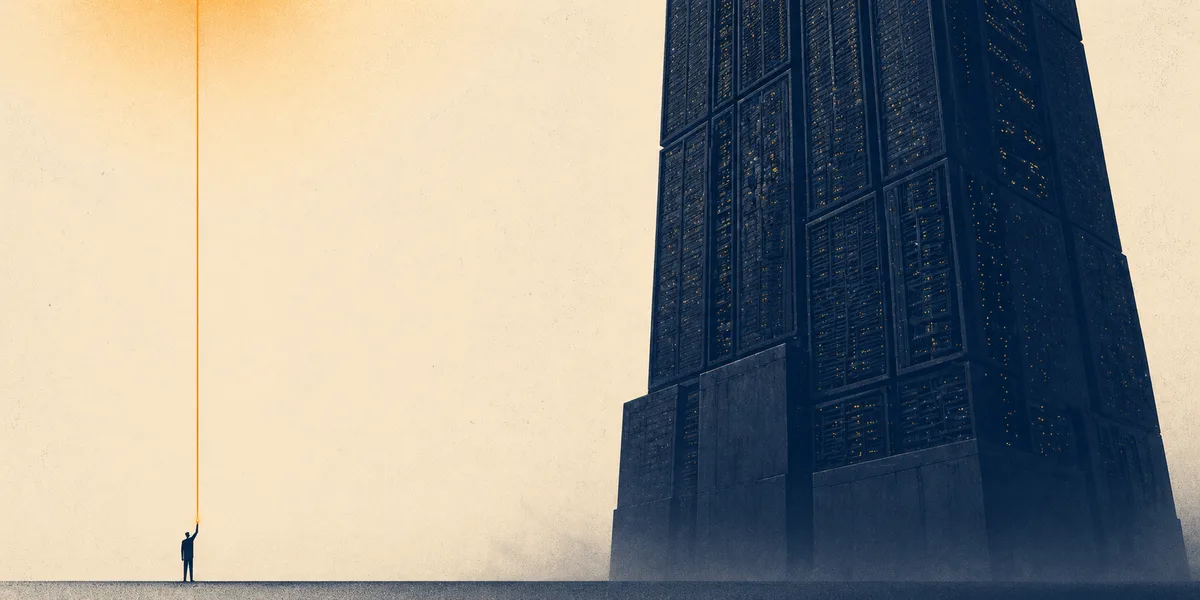
Imagine you could take over an entire Amazon Web Services (AWS) region.
If you’re not technical: AWS is the infrastructure that runs massive portions of the internet. A “region” isn’t one building — it’s multiple enormous data centers filled with staggering amounts of computing hardware. Hundreds of thousands of servers. Likely far more. A meaningful slice of the world’s total compute.
Now imagine all of it is yours for one task.
Could you use it to “crack Bitcoin”?
By “crack Bitcoin,” I mean this: could you break the cryptography that protects a single Bitcoin wallet — the mathematical lock that prevents anyone from stealing someone else’s coins?
The answer is no.
Even with an absurd amount of computing power, it would still be effectively powerless.
On average, it would take roughly:
10,000,000,000,000,000,000 years
Ten quintillion years.
Written out in full because your brain probably doesn’t register “10¹⁹” as anything real.
That’s not expensive.
That’s not difficult.
That’s not “give it a few centuries.”
That’s a category failure.
Why this matters
We assume that enough scale solves anything.
More power.
More intelligence.
More leverage.
More infrastructure.
If something is hard, the solution must be “more.”
But Bitcoin’s cryptography quietly proves something uncomfortable:
Some problems do not care how much power you throw at them.
You are not “getting closer.”
You are simply applying the wrong category of power.
Even one of the most powerful computing systems on earth — an entire AWS region — cannot meaningfully dent the problem.
Even absurd power can be powerless.
Humans as small instances
In AWS there are tiny machines and massive ones.
A small instance might have one CPU and limited memory. A massive one might have dozens of processors and enormous capacity.
A human being is like a very small instance.
We get tired.
We’re limited.
We can only hold so much in our head at once.
Even the most exceptional person is still running on finite hardware.
You might imagine upgrading yourself:
- smarter
- stronger
- more disciplined
- more influential
That’s like upgrading to a larger instance.
Impressive — but still the same category.
Bigger doesn’t mean different
Here’s the key insight.
A tiny cloud server and an entire AWS region are wildly different in scale — but they are still the same kind of thing. They run code. They follow physical laws. They are bound by the same mathematical limits.
Scaling doesn’t change what category of problem you can solve.
It only lets you solve more problems of the same type.
That’s why an entire AWS region — something that feels almost godlike in modern terms — is still helpless against certain cryptographic problems.
It’s not weak.
It’s simply not the right kind of thing.
“Apart from me you can do nothing”
This is where Christianity makes a statement that sounds outrageous:
Jesus says, “Apart from me you can do nothing.”
Nothing?
That feels exaggerated. Of course humans can do things. We build cities. We invent technology. We land rockets.
But that verse isn’t denying activity.
It’s denying ultimate independence.
In context, Jesus compares himself to a vine and his followers to branches. A branch can look healthy. It can appear strong. But if it is cut off from the vine, it eventually produces nothing.
Not less fruit.
Not weaker fruit.
Nothing.
The claim isn’t that humans lack ability.
The claim is that separated from the source of life itself, our power collapses in categories that matter most.
Just like an AWS region is helpless against certain math, we are helpless against certain realities.
The potter and the clay
There’s another passage that often gets misunderstood.
In Romans, Paul uses the image of a potter and clay. He says the clay doesn’t get to question the potter about its purpose.
That can sound harsh unless you understand what he’s addressing.
He’s not saying humans are disposable.
He’s not saying effort is meaningless.
He’s saying something deeper:
The created thing does not define its own purpose.
The clay doesn’t scale itself into a different role. It doesn’t become the author of its own design.
This is about authority — not strength.
No matter how powerful a created thing becomes inside the system, it never becomes the system’s author.
Free will: align or isolate
So what does free will mean in this framework?
It doesn’t mean we force outcomes.
It doesn’t mean we override reality.
It means we choose alignment.
We choose whether to remain connected or isolate ourselves.
Whether to depend or to self-execute.
Whether to participate in something larger or pretend we are self-sufficient.
Prayer isn’t a hack.
It isn’t a demand.
It’s participation.
It’s like a tiny instance making a call to something infinitely beyond itself.
And yes — that requires faith.
Why weakness isn’t a bug
There’s something deeply protective about our limitations.
If we were powerful enough on our own, we would stop depending.
We would confuse scale with sovereignty.
We would believe we were self-created.
That mistake has a name in Christian theology — pride.
Weakness keeps the boundary visible.
It reminds us what category we are.
The illusion of “almost anything”
Right now, with AI and global infrastructure, it feels like humanity can do almost anything.
We can generate code.
Simulate intelligence.
Solve problems in seconds that used to take days.
It’s intoxicating.
But even AI — even the most advanced systems on earth — are still in the same category.
They scale compute.
They do not transcend it.
They are still bounded.
We have gotten dramatically better at the problems scale can solve. We have not moved one inch closer to the problems it cannot.
The real takeaway
The modern world assumes every limit is quantitative.
Add enough power, and the problem falls.
Bitcoin proves that’s false. Christianity explains why.
Some limits aren’t about effort. They’re about what kind of thing you are.
No amount of scaling turns a created thing into its creator.
No amount of compute turns a bounded system into an unbounded one.
No amount of striving turns a branch into the vine.
The gap between categories isn’t closed by climbing. It’s closed by connection.
A whole AWS region can’t crack one wallet. And the most capable person who ever lived, equipped with every tool civilization has ever produced, still cannot author their own meaning, secure their own soul, or outlast their own death.
Those aren’t engineering problems.
They are category problems.
And the answer to a category problem is never more.
It’s something else entirely — something received, not built.
The thing that matters most was never on the scaling curve.
It’s relationship with the Author — of the curve, the categories, and you.